





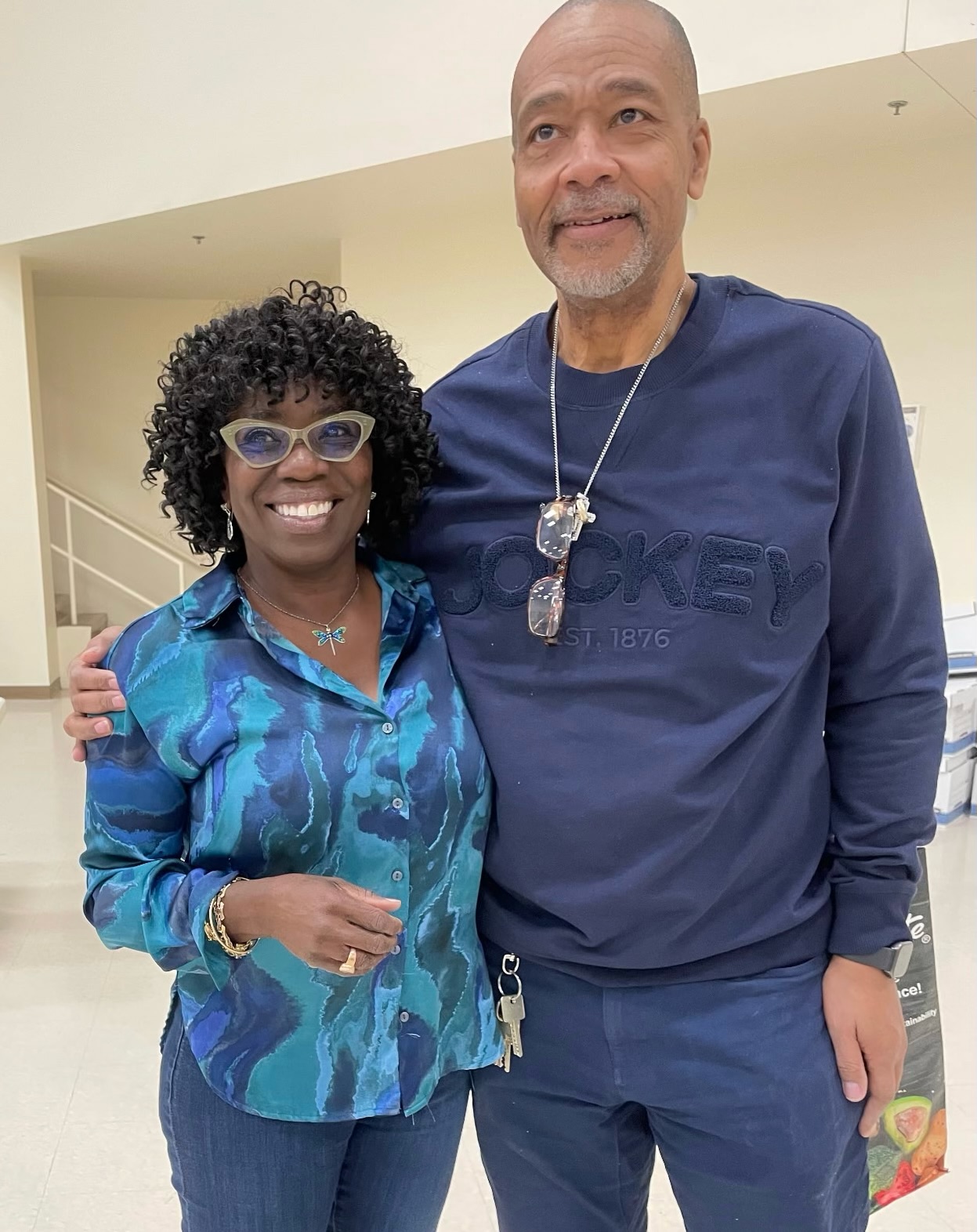
Enon’s first lady Ellyn Jo Waller, Ph.D., with Rev. Jerome Glover Sr., Associate Pastor of Preservation Community, oversees the conference operations.
Photos courtesy of ENON Tabernacle
By Constance Garcia-Barrio
One could say that the annual “She’s My Sister” anti-human trafficking conference, held this year on January 24 at Enon Tabernacle Baptist Church, stands as a testament to human resilience. Led by Enon’s first lady, Ellyn Jo Waller, Ph.D., the conference included virtual and in-person presentations by women who had left “the life,” which is another name for being trafficked, transformed themselves, and thrived.
A symposium Waller attended years ago sowed the seeds for She’s My Sister, which takes place each January, which is Human Trafficking Awareness Month.
“I was at a conference in Washington, D.C., where a gentleman spoke about human trafficking in South Africa,” Waller said. “I began doing research and learned about human trafficking here. It changed my life.”
Waller, joined by allies, launched She’s My Sister.

Top and bottom photos: Volunteers and members curate supplies for human trafficker survivors during last week’s the annual “She’s My Sister” anti-human trafficking conference.
Photos courtesy of ENON Tabernacle

“The name of the conference reminds people that trafficking can happen to anyone,” Waller said.
Saturday’s free event, attended by several hundred people, marked the conference’s thirteenth year.
“Human trafficking is a type of human rights abuse where people profit from the exploitation of others – mainly using force, fraud or coercion to manipulate victims into engaging in sex acts or labor/services in exchange for something of value,” according to a January 2025 news bulletin from the Unified Judicial System of Pennsylvania. Sadly, Pennsylvania ranks among the top 10 states for human trafficking, according to Rep. Steven Mentzer (D- 97th Dist.), which includes parts of Lancaster County.
Disrupt Human Trafficking, a U.S. nonprofit that supports women and fights trafficking, estimates that earnings from trafficking surpass $150 billion a year.
Pennsylvania’s high ranking sounds an alarm, and upcoming events this year add more urgency to educate the public.

Photo courtesy of ENON Tabernacle
“With the nation’s 250th anniversary celebration and FIFA, we’re going to potentially see an uptick in trafficking,” said Rep. Morgan Cephas, (D- 192nd Dist.).
City Councilmember Nina Ahmad, Ph.D. (At-Large), who has long partnered with Waller, also sees a heightened need for informing the public, given this year’s events. Her awareness of the devastation caused by sexual violence and human trafficking has roots in her past.
Ahmad, born and raised in Bangladesh, recalls that hundreds of thousands of women and girls were systematically raped by Pakistani troops during the 1971 Bangladesh War of Independence.
“Traffickers look for vulnerable people, for example, those struggling with issues like poverty, homelessness, and mental illness,” Ahmad said.
“Traffickers present themselves as saviors eager to solve the victim’s problem. Intended victims don’t realize that they are being groomed for trafficking.”
Ahmad pointed out that human trafficking masquerades as everyday activities unless one knows the signs to look for. She proposes a campaign of awareness to educate Philadelphians ahead of the city’s celebrations.
Ahmad also emphasized focusing on vulnerable groups.
“Just as parents and guardians of young children discuss the difference between good touch and bad touch with them, we must have similar conversations with older children about trafficking,” she said. “Those conversations aren’t easy, but they’re necessary.”
Ahmad has secured $500,000 for a citywide human trafficking awareness and prevention campaign in partnership with the Office of Public Safety.
The conference included exposing myths about trafficking. For instance, it was explained that not just women and girls are trafficked. About 40% of victims are men and boys, according to data presented. Likewise, it was noted that most victims aren’t trafficked by strangers, but by someone they know and trust.
Trafficking survivor Rosalie Odom gave a pull-no-punches presentation virtually from Memphis, Tennessee. Sexually molested from ages 3 to 10, she was primed for victimhood, she said. In her teens, she had three babies due to trafficking. Authorities took them from her, she said. At a low point, she promised God, “I will give you my life if you help me.” In time, she left her old life and found a nurturing relationship.
A hard-hitting documentary, “The Right Track,” showed that trafficking takes place throughout North America by showing scenes from different cities and Canada. The film included women being beaten by their pimps. It also pointed out that arresting trafficked women amounted to punishing the victim.
“The public needs to be educated and not buy sexual services,” a narrator said.
The documentary ends on a triumphant note, with formerly trafficked women helping to demolish a site where prostitution took place.
Panelists included two survivors of trafficking who discussed their experiences and also explained how they left their old lives behind. One woman’s sister kept approaching her and offering help, which the trafficked woman finally accepted. The second woman said that her faith in God let her make a new start.
The Salvation Army’s New Day to Stop Trafficking also offers a way out.
“We support survivors throughout drop-in center and Police Assisted Diversion (PAD),” said Kelly Devlin, director of Philadelphia Social Services Ministries with the Salvation Army of Greater Philadelphia.
The drop-in center supplies food, clothing, and other basics. The New Day New Home initiative provides transitional housing, rapid rehousing, and case management, she said.
“We also provide training in recognizing signs of trafficking,” Devlin said.
To learn more about opportunities in anti-trafficking, or to donate or volunteer, please email: [email protected].
For immediate support, call the Philadelphia 24/7 anti-trafficking hotline at: 1(267) 838-5866.
To contact the National Human Trafficking hotline to report a tip or connect with anti-trafficking services, call: 1(888) 373-7888.
Related Posts
 Enon Tabernacle Baptist Church aims to stop human trafficking in Philadelphia and beyond
 In Our Backyard: Human trafficking in Philadelphia — Part Two: How the faith-based communities are addressing trafficking
 Enon Tabernacle Baptist Church bridges the gap between young women and evils of human trafficking Pt. 3






Leave a Comment