





9-11 Schuylkill Memorial
Photo by Zachary Emerson
By Raymond Jones
Joggers slowed down to a trot, peering at the crowd and walkers, deviating from their daily exercise on the Schuylkill Banks, just South of Chestnut Street, quietly and slowly joined the circle of 70 somber men and women. The group stood around the 9-11 Schuylkill Memorial, located near Chestnut Street bridge, in remembrance of the almost 3,000 people who died in the terror attack on the World Trade Center in New York City, 25 years ago.
“I lived in Bayonne (a city outside of New York City but close enough to see the skyline of Manhattan from I- 95 North) with my fiancé at the time,” Rory James, 64, said. “It was a frightful time. I used to work at an office building in downtown Newark. Everyday after 911, there was a bomb threat. So, everyday you didn’t know if that day was going to be your last.”
The 9-11 memorial itself is a shocking reminder of the collective grief and horror Philadelphians continue to feel 25 years later. The design is a piece of steel, twisted by the explosion from the World Trade Center, presented by the Port Authority of New York and New Jersey. Inscribed on the base are the names of Philadelphians who lost their lives in the attack: Jasper Baxter, Kevin Leah Bowser and Christopher Robert Clarke.
The event was organized by the Aurora Classical group. The organization specializes in making performances accessible to traditionally economically marginalized communities.

Names of Philadelphians who perished in the 9-11 attacks.
Photos by Zachary Emerson
The silence between speakers was deafening as people struggled to express in words reactions to an unthinkable occurrence that only feelings could adequately define. People began to motion to the facilitator when they wished to speak, as memories, so long ago packed away, began to resurface. A young white man, no older than 30, talked about growing up in the shadow of 9-11, the uncertainty, the anguish, associated with that day. An older woman of Asian descent with shocking gray hair, lightly dabbed her eyes underneath her glasses, sharing that she has never really been the same since the tragedy, explaining that her sense of personal innocence and security had been forever lost when the Twin Towers were destroyed. As the crowd dispersed, some still struggled with the collective grief that began 25 years ago.
“I was there in Washington when it happened working for Bell Telephone laying cable,” said Garfield Thompson, 70. He looked away briefly, his memory taking him back to that time. He paused his responses, between his Jamaican lilt accent, then said he couldn’t talk any longer.
In addition to the national recognized memorials at New York City Ground Zero, Arlington, Virginia, and Shanksville, Pennsylvania, this event on the Schuylkill riverbank was just one in thousands of memorials that took place in cities, military organizations, fire houses and police stations across the country.
On September 11, 2001, 19 terrorists from the group al-Qaeda hijacked four commercial airplanes to carry out coordinated suicide attacks in New York, Washington DC, and Pennsylvania. Over 3,000 people died during the tragedy with possibly hundreds dying later due to injuries and cancer related deaths over the last 25-years.
Philadelphia native Deirdre Church, 45, says she remembers that day vividly as a student attending Florida A&M.
“A dean came into our class and said a plane hit the towers. I thought it was a private plane. One of those individual planes with two or three people in it just accidentally hit it. When she came back into the class and said a second plane had hit the other building, we were all dismissed,” Church said.
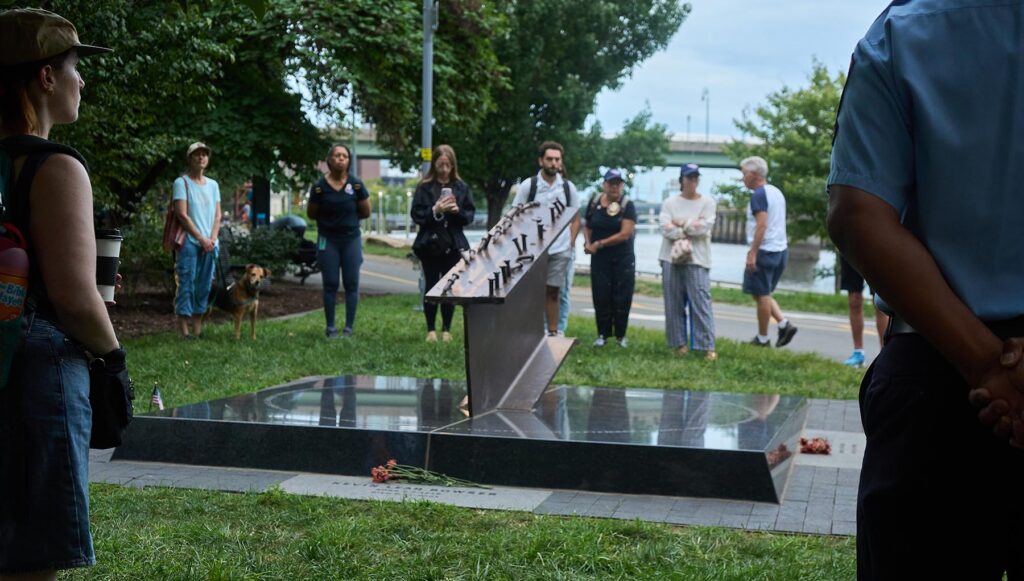
Guests pay respects to the victims at the 9-11 memorial.
Photo by Zachary Emerson
Church, in a dorm room with her two friends, sat glued in front of the TV, watching the news, holding hands and praying.
“I just felt that 9-11 impacted the whole country, and so I think it is an important day to honor all those who suffered, those who served and all those who are still suffering,” Church said. “So, I just wanted to honor them with my presence.”
September 11, 2001 left many visible changes to the nation. Early check-in lines, the invention of Homeland Security, Real ID, heightened racism directed towards Muslims. What remains invisible — and is perhaps the deepest lasting effect of 9-11 — between the memorials, documentaries, and the living of everyday life, are the emotional scars many continue to carry in silence.







Leave a Comment